The June 2026 SimplyWise Trades & Technology Index
Our 2026 skilled trades survey of how Gen Z sees AI, college, and the future of work.
SimplyWise builds software for tradespeople and contractors. The SimplyWise Trades & Technology Index is a skilled trades survey tracking how young Americans think about the trades, higher education, AI, and career opportunities. Future editions will allow for trend analysis.
June 2, 2026
Overview
For two generations, the advice to American teenagers was simple: earn a four-year degree. The June 2026 SimplyWise Trades & Technology Index, a skilled trades survey of 1,140 Gen Z adults, suggests that consensus is beginning to weaken as Gen Z weighs the costs, risks, and opportunities of a rapidly changing economy.
Across 1,140 Gen Z adults ages 18 to 29, this skilled trades survey finds a consistent picture. Asked which careers are safest as AI reshapes the economy, Gen Z points away from the office and toward the job site. They are nearly as likely to choose a trade as a degree when they imagine starting over. And they extend the trades something earlier generations often withheld: respect.
The shift is not absolute. The four-year degree remains highly valued, and on several measures, college and trade school finish in a statistical tie. However, the direction is clear, and it is especially pronounced among those with the most at stake: current college students and young people pursuing careers in technology.
Key findings at a glance
College Is No Longer the Automatic Choice
Gen Z has not turned against college. They have stopped treating it as the default path to success. When asked which path is most likely to deliver financial stability by age 30, more respondents choose trade school or an apprenticeship (34%) than a four-year degree (23%). Indeed, nearly half (49%) say they would pick trade school over college if they were choosing today. Even among students already enrolled in college, one in three (35%) say the same.
At the same time, attitudes toward higher education remain nuanced. About half of respondents (49%) said a four-year degree is worth the cost. Yet when asked what path they would choose today if starting over after high school, Gen Z was almost evenly split between a four-year college (26%) and trade school or an apprenticeship (25%).
The findings suggest that college remains highly valued, but no longer enjoys the clear preference it once did among young Americans.
Source: SimplyWise Trades & Technology Index (June 2026), n=1,140, Q9.
The trades look like shelter from AI
Ask Gen Z which careers are most vulnerable to AI, and conventional wisdom gets flipped on its head. Software developers, accountants, and graphic designers top the list of occupations they believe are most at risk. In fact, 38% rank developers as the single job most likely to be disrupted by AI over the next decade. The skilled trades sit at the opposite end of the spectrum. Nearly 45% of respondents rank HVAC technicians as the safest occupation we tested, while 42% place plumbers among the two safest careers. Across all six occupations, software developers, accountants, and graphic designers form a clear “high-risk” tier, while electricians, plumbers, and HVAC technicians are viewed as substantially more insulated from AI-driven disruption.
Exactly 50% of those surveyed say AI has already changed how they think about their career. The shift tends to favor occupations perceived as less vulnerable to automation, particularly skilled trades and other forms of hands-on work: 46% say the trades feel safer than office jobs in an AI future, a figure that climbs to 52% among those already enrolled in college.
Source: SimplyWise Trades & Technology Index (June 2026), n=1,140, Q4.
The people closest to tech are the most worried about AI
The sharpest signal comes from the people most interested in building the technology itself. Among Gen Z respondents looking to enter a career in tech or software, 73% rank software developer among the jobs most exposed to AI disruption, compared with 68% of respondents overall. In other words, those most interested in entering the field are also among the most likely to view it as vulnerable to AI. When asked which careers appear safer, they tend to point toward the skilled trades.
Source: SimplyWise Trades & Technology Index (June 2026), n=1,140, Q4 (derived).
Skilled trades have gained status among Gen Z
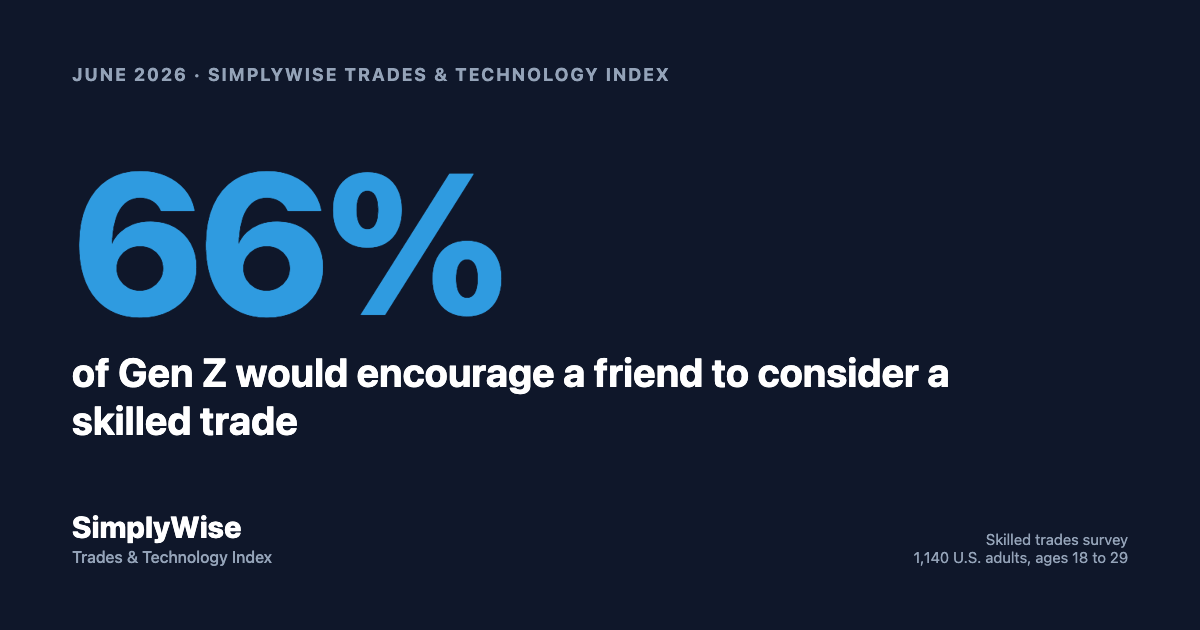
The survey suggests that changing attitudes toward the trades extend beyond economics. Two-thirds of Gen Z (66%) would encourage a friend to consider a skilled trade, while only 10% said they would discourage it. Seven in ten (70%) say their generation holds the trades in higher regard than it did a few years ago. Notably, when asked which single career path earns their respect most, skilled trades ranked first (30%), ahead of small business ownership (22%), academic and professional careers (12%), corporate careers (12%), and technology and AI careers (10%).
Source: SimplyWise Trades & Technology Index (June 2026), n=1,140, Q13.
Personal experience shapes views on higher education
Behind the numbers is something many of these young Americans have seen firsthand. A majority (54%) said they personally know a college graduate who is struggling financially. That experience appears to influence career preferences. Among those who know a graduate struggling financially, 57% say they would choose trade school over college. Among those who do not know such a college graduate, that figure falls to 44%.
The findings suggest that personal exposure to graduates facing financial challenges may contribute to growing interest in trade schools and apprenticeships among young Americans.
Know a struggling college grad
Do not know one
Source: SimplyWise Trades & Technology Index (June 2026), n=1,140, Q8 and Q14.
In their own words
We also asked respondents to describe, in their own words, how AI has influenced the way they think about careers and the future of work. Their responses reflect many of the themes seen throughout the survey, including concerns about automation, uncertainty about traditional career paths, and growing interest in hands-on occupations.
The wider context
These findings are consistent with broader trends in the U.S. labor market. The U.S. Bureau of Labor Statistics expects electrician jobs to grow 7% between 2024 and 2034. That is more than double the 3.1% pace for all occupations. Electrician jobs earn a median wage near $60,000 a year, and many enter the profession through apprenticeships rather than four-year degree programs.
At the same time, public confidence in the value of higher education has softened. The 2024 Pew Research study, “Is College Worth It?”, traces the same growing skepticism about whether a four-year degree is worth the cost. The attitudes expressed by Gen Z respondents in this SimplyWise Trades & Technology survey reflect many of the same questions about career security, return on investment, and long-term economic opportunity.
What it means
The findings of this skilled trades survey suggest that many young Americans are rethinking long-held assumptions about education, career security, and economic opportunity. While college remains a valued path, it no longer appears to hold the clear advantage it once did. Across multiple measures, respondents viewed skilled trades as offering a compelling combination of financial stability, job security, and resilience in an AI-driven economy.
Perhaps most notably, these attitudes are not limited to those already working in the trades. Current college students, aspiring technology workers, and young adults broadly expressed many of the same concerns about automation and the return on investment of a four-year degree.
Finally, whether these views translate into long-term changes in educational and career choices remains to be seen. Future editions of the SimplyWise Trades & Technology Index will track how perceptions of skilled trades, higher education, and AI continue to evolve.
Methodology and limitations
This skilled trades survey was an online poll of 1,140 U.S. adults ages 18 to 29, fielded via SurveyMonkey Audience in May 2026. The sample is a non-probability, opt-in panel and is not weighted to U.S. population benchmarks. As with all opt-in samples, a classical margin of error does not strictly apply, and results should be treated as directional. The respondent pool skews toward lower household incomes, consistent with a young, early-career population. A separate screened sample of working tradespeople (n=38) was too small to support quantitative estimates and is used only for qualitative context. Percentages may not sum to 100 due to rounding. Question wording for every figure cited appears in the appendix below.